November 12, 2026
What I See
How Humans Work
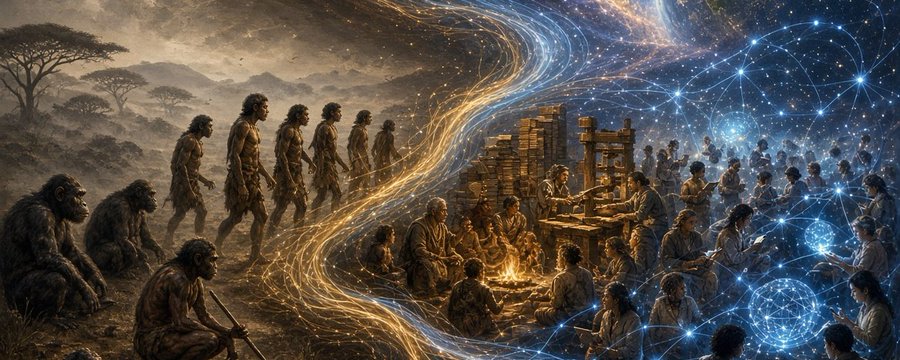
I see billions of members of the Great Ape family. Cousins of chimpanzees bonobos, with a shared ancestor somewhere between 5 and 7 million years ago.
Our species, Homo Sapiens, has developed advanced spoken and written language that is able to express abstract thoughts like the idea of a nation, an economic system, or a religion.
Different communities of humans separated by distance or time developed different cultures. Ideas, or memes (a unit of cultural transmission), spread easily from person to person, we understand each of these ideas within a larger learned understanding of reality.
There is no place or period of time that we could point to and say "this one was correct, and all of the others were wrong", including our own. Each individual is limited, flawed, manipulated and overconfident in their own opinion. Ideas shared within the community are more likely to be believed, even when they are opinion rather than fact.
Our particular time and place is unique across all of history. For the first time ever, individual to individual communication is possible all around the world, with built in translation available if needed.
For millions of years humans have existed as tool using apes.
For the last 50,000 to 300,000 years, we've had the ability to express complex thought. This allowed us to think and communicate beyond things that are real, to abstract ideas, like Gods.
Stories were shared person to person, with variations spreading, like a long game of telephone over time and space.
Stories adapted with cultural change over time, either expressing the same ideas in more modern language, or in some cases losing the original idea entirely.
Closer to 6,000 years ago, we began developing written languages, which allowed the content to be more stable over time. While not everyone had the ability to read the text, two people who were able to read were able to tell the same story, down to the last word.
Hundreds of years ago, the invention of printing press made access to books much more common, which led to a greater number of being learning to read.
Each of these steps had tremendous impact to the the spread of ideas through humanity. Major religions spread all over the world, and specific ideas from different cultures impacted the people who were exposed to them in new and interesting ways.
Humanity, as a whole, learned. Rather than spending a lifetime gaining personal experience, we're able to get a jump start on our learning through prepared education starting at an early age. Ideas were able to last long after the death of its creator.
We were able to build more and more complex systems in order to gain more and more capabilities. This has led to our particular unique moment in history.
We now exist with access to the whole of human knowledge available at our fingertips, along with even more garbage ideas. We can trivially speak to people from any country. Often it feels more common to encounter people who are confidently wrong or actively lying than someone who truly understands their place in the universe.
We also exist as deeply tribal beings. We're able to extend trust beyond individuals that we know personally through a sense of shared community and narratives.
None of these narratives are "complete" truths. Reality is always more complex than any human imagined concepts. Concepts are lenses to view reality through. They will never cover everything you can see. They do not control our behavior. They can be useful, but they are not Facts.
The tao that can be told
is not the eternal Tao.
The name that can be named
is not the eternal Name.The unnamable is the eternally real.
Naming is the origin
of all particular things.Free from desire, you realize the mystery.
Caught in desire, you see only the manifestations.Yet mystery and manifestations
arise from the same source.
This source is called darkness.Darkness within darkness.
The gateway to all understanding.-- Lao Tzu "Tao Te Ching" Chapter 1 (Mitchell translation)
We live or die by our actions, but our actions are driven by our narratives. New narratives can unlock new patterns of behavior. Creating new narratives requires communication.
While we watch people fight for power, real change waits for us to realize that how we behave is more important than the exercise of raw power.